What we ask of dogs
FIELD NOTE #001
Where: Northern Scandinavia
Season: Autumn · Winter · Spring/Summer
Time in the field: Seven working seasons
Observation: The choices we make for sled dogs are shaped by much more than our intentions.
It is the beginning of the afternoon. I refill my mug with coffee and step outside into the August sun. The brightness blinds me for a moment.
It’s warm, with a slight breeze carrying the scent of autumn coming in.
I take a seat on the steps of the red summer cottage and a big sip of my coffee. I look over to my left. There is Grim, a ten-year-old Alaskan husky, snoozing in the high grass.
Grim used to be an amazing sled dog. A lead dog. Almost like a joystick, he would lead my friend Bjørn and the rest of the team through any situation.
I’ve heard stories of Grim going head-on into the biggest winter storms.
The type where human senses shut down. No sight. Wind screaming in your ears. -25 degrees. Snow and ice scratching your face. All you can do is make sure you hold on to your sled and trust the dogs to take you home.
And they will… always.
On my right is Navara, a four-year-old Alaskan husky. Navara also used to be a sled dog but didn’t make ‘the cut’. She was on the adoption list at the last kennel we worked at because she refused to run as soon as the first snowflakes fell and guests started coming into the dog yard.
She is sitting patiently in front of a tree as the birds hop from one branch to another, chirping loudly. Navara’s ears move in separate directions, following the sounds around her.
She can sit there for hours at a time. Just watching and listening. To birds, squirrels and the wind carrying the sounds and smells of the Värmland countryside.
‘You guys are lucky…’ I catch myself saying out loud.
I just got out of a video call for a job interview. A kennel looking for experienced guides for the upcoming winter season.
The website looked promising, with all the right words: animal welfare, sustainability, happy dogs.
But with every question we asked, another red flag was raised.
Do you free run the dogs? Aha, only in summer? Okay… How many dogs at the same time? Two to four… hmm. Ah, they’re not used to free running with more than four at a time? Yes, you want to minimise fights and injuries…
It’s been hard to find a fitting guiding job for the upcoming season. One that matches our values and expectations, while allowing us to make a decent living along the way.
I’m starting to question whether there are fewer ‘good’ kennels out there, or whether working in the industry for several seasons has simply changed the way I see it.
I take another sip of coffee, trying to flush away the stone sitting in my stomach, and think about some of the people I’ve met over the last few years.
I have met people in this industry whose choices around dogs I strongly disagree with.
And I have liked some of those people very much.
There was a freelance musher with 24 dogs of his own. He was passionate about them and loved telling us about their personalities, about sledding and how amazing it is. The dogs provided an income for him, his wife and their two young children.
In summer, however, the dogs were kept on a stake-out line in the forest. A long line with individual tethers attached to it, each dog with its own doghouse.
For seven weeks.
They were fed twice a day and had water, but never came off the stake-out during those seven weeks.
Feeding those dogs was one of the most difficult things I had to do while working at a kennel.
Their owner would stop by every now and then, bringing the staff beer, chocolate or a voucher for groceries. He didn’t have to do that. We were working for and being paid by the company that had agreed to take in his dogs for the summer.
‘We can take them off the stake-out and free run them for you?’
‘No, not necessary. They’re not used to it…’
Then there was the famous musher. A big reputation. He had finished one of the hardest and longest long-distance races in the world several times.
‘He speaks dog,’ I was told.
That’s someone I would like to learn from!
And it was true. He did speak dog.
When he entered the kennel, you could feel the energy shift. All the dogs would sense him straight away and move into this calm, focused state. They would settle down. No more barking or moving around in their cages. They would just watch him as he moved through the kennel.
I saw him with the sensitive dogs. The hard-to-work-with ones. The dogs you sometimes couldn’t get out of their cages when they were supposed to run a tour. The ones I had been trying to connect with for weeks.
He would take a knee and talk to them softly.
And they would just walk up to him for a cuddle.
These dogs hardly knew him. He had retired from running the kennel some years before and was now focused on other business ventures.
It was magical. One of the most beautiful human-animal interactions I’ve ever witnessed.
And yet I have seen this same person treat people in awful, condescending ways, take advantage of them for his own gain, and make business decisions I strongly questioned, affecting both people and dogs.
Then there was another person. Passionate, inspirational, with a big online presence and actively pushing for better animal welfare within the industry.
Someone I thought I would love to work with.
I was talking to him about his work around rehoming sled dogs. He was setting up an industry network, trying to create change beyond his own kennel.
Then, in that same conversation, he told me about running his dogs in Santa Claus Village in Finland.
The dogs run the same short loop 30 times a day. Because they are constantly running in the same direction, he explained, they need additional massage and care as one side of their bodies becomes more vulnerable to injury.
And then came the other side of the story.
In those few weeks, he told me, they make more than 30% of their annual income. Money that allows them to upgrade the kennel and employ qualified staff year-round — people who know these dogs and can take good care of them throughout the rest of the year.
I believe all of these people care deeply about their dogs and dog sledding, trying to do good and take care of their families.
I could have walked away while feeding those dogs for seven weeks on a stake-out… but I didn’t.
I remember my very first kennel, where after a dog fight I would free run the dogs four at a time because I was scared of another fight.
I’ve forced dogs to run that didn’t want to because otherwise they would not exercise, or even come out of their cages, for days.
I’ve stayed in places hoping things would eventually change because winter in the Arctic is dark, long and very cold. People are tired. Unexpected things happen. Things don’t go as planned.
You just stick it out. Try to make things better along the way.
You need a paycheck and a roof over your head.
That’s not an excuse.
It’s the reality of working in an industry where dogs, people, livelihoods and tourism are deeply intertwined. Sometimes it feels obvious when something isn’t right. More often, I’ve found myself somewhere in the grey between.
So perhaps the question isn’t where exactly the line is, but what we do when we find ourselves approaching it. Who carries the responsibility to question what has become normal — and who has the power to change it?
But there is another question I keep coming back to:
What allows people to make good choices in the first place?
Because none of these choices exist in isolation.
Underneath them runs an entire system: seasonal economics, peaks around Christmas, hiring and training staff, dogs needing year-round care, the cost of food, kennel maintenance and vet bills, regulations, unpredictable winters, families depending on an income, impact on local communities, traffic, staff housing — and the list goes on.
Guests encounter only a small part of a dog’s life.
They don’t see the system underneath it. They don’t see autumn training, summer, retirement, or the dogs that don’t want to run.
And we tell them very little about it.
We focus on the beauty.
The traveller sees excited dogs, snow, wilderness, beautiful landscapes, fika by an open fire, perhaps the northern lights. We tell them about our favourite dogs and their personalities. The extraordinary things they’ve done. Who is the funniest. Who is the best cuddler.
We tell them what it’s like to sled down a mountain with eight dogs pulling you, or to find your way home in a snowstorm.
And yet we get annoyed when guests want their picture with the blue-eyed husky but barely acknowledge the dogs that have just pulled their sled for an hour. On particularly rough days, I’ve even caught myself thinking, in frustration, that perhaps dog sledding simply shouldn’t be accessible to everyone.
But we are the ones inviting them into this world.
They experience one, maybe two hours of a dog’s life, and we decide what part of that life they get to see.
Perhaps we cannot expect travellers to understand the life behind the experience if we only show them the beautiful parts.
I remember the first time I went out sledding alone. It was at my first kennel, and Junior was my lead dog.
Junior was a fairly small Alaskan husky. A male. Away from the sled, he was shy and somewhat skittish.
But as soon as you put him in front of a team, he became a different dog.
His whole body language changed. He made himself big. Chest out, head held high, pulling the line as tight as possible. Ready, like a sprinter at the start of a race.
And Junior was the boss.
He did not take shit from any of his colleagues. Even the younger males, twice his size and high on testosterone, would fall in line when they ran next to Junior.
So here I am. Alone in the Swedish wilderness with six dogs.
The sun is shining. It’s around -15 degrees. The dogs are running at a beautiful pace, just trotting along. The only sounds I hear are their paws tapping on the snow and their breathing.
I’m taking it all in.
Until at some point I look around and realise…
I have no clue where I am.
Then I see a turn coming up that I think I recognise.
‘Haw,’ I tell Junior.
Left.
As we take the turn, I realise my mistake.
This is the turn we shouldn’t take.
The trail stops just ahead of us. Beyond it is nothing but deep snow. Any trail continuing from here would become extremely bumpy and run alongside a dangerous ridge.
I tell the dogs to stop and brake as fast as I can, but we’ve already ended up in the deep snow.
I know I have to turn the sled around.
I have never done this alone before. A 180-degree turn from a standstill, with no space to make a small loop.
I know I probably have to get off the sled, but that is the very last thing I want to do. I’m scared to put my anchor into the deep, loose snow. What if it doesn’t hold? The dogs could take off, and there is no way I would be fast enough to catch them while ploughing through the snow.
‘Haw, haw, haw,’ I call out.
Again and again.
And with every ‘haw’, my voice becomes a little more panicked.
My stress spills over to the dogs. They start getting restless, pulling in different directions.
Junior is still holding the line.
He keeps looking back at me, his ears moving back and forth, trying to figure out what I want from him.
At some point, I stop.
I take a deep breath.
I realise I have to get off the sled, walk up to Junior and show him which direction I want him to go.
Okay. Let’s try one more time.
Junior looks back at me.
I look him in the eye and say it once, calmly and firmly.
‘Haw.’
This time the sound comes from deep within my chest instead of somewhere at the top of my lungs.
Junior makes himself big. His little chest comes forward. His ears go up.
And for a moment we just look at each other.
It is as if he says: I got you.
Junior starts pulling left, keeping the line tight as he goes. He guides the entire team around in a perfect half-circle, turning my sled 180 degrees without pulling it forward.
‘Okay, hike!’
The dogs start pulling.
They pull me out of the deep snow, back onto the trail and towards familiar paths again.
That moment with Junior, right there, is when I fell in love with dog sledding.
I’ve had dogs all my life, but this was something different.
This teamwork. This connection.
Dog sledding has brought me closer to nature — and to my own nature — than I have ever been before.
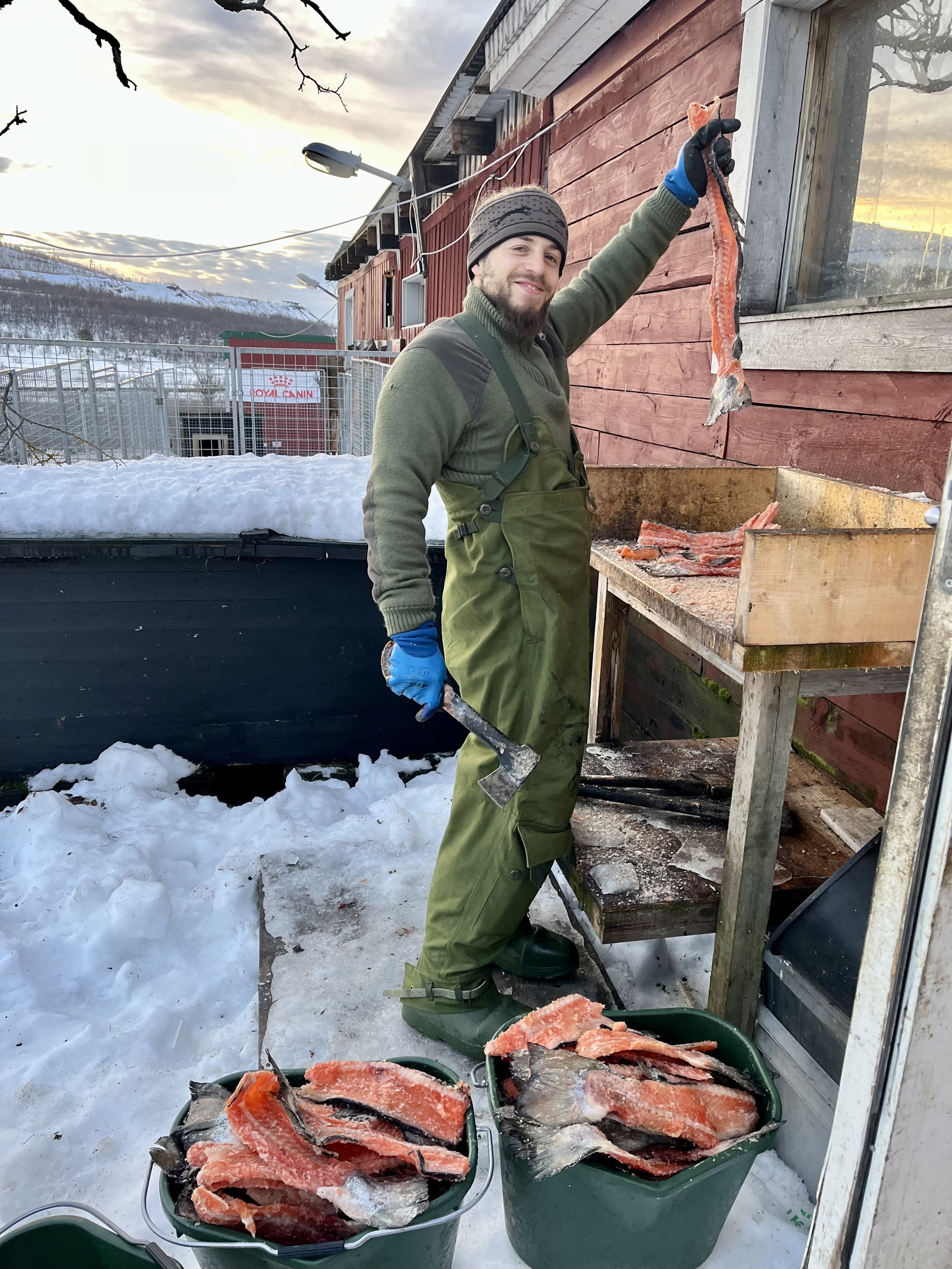
It’s not that I haven’t encountered kennels that I would call good. I have.
Many of them have been small. Family-run kennels where the dogs live on the same property as the people who care for them. It’s not so much a business as it is a way of life.
They often offer private tours rather than several departures a day. Multi-day journeys with small groups. Fewer dogs, fewer guests and often very few paid staff.
And for some, tourism isn’t even the reason they keep sled dogs. They are mushers first. They train and compete in long-distance races, and tourism helps finance the life that comes with it — feeding and caring for the dogs, equipment, training, travelling and entering races.
There is something appealing about that model. The distance between the people making the decisions and the dogs living with those decisions seems smaller.
But it comes at a price.
These experiences tend to cost more. There are fewer places available. Some kennels rely heavily on volunteers or staff willing to accept lower wages in exchange for accommodation and the chance to live this life.
I have met people who barely earn enough from their tours to cover the cost of keeping their dogs and pursuing the sport. Others deliberately choose to make just enough to sustain that life and are quite open about tourism not being what brought them to this life in the first place.
And this brings me back to the question I keep asking myself:
What allows people to make good choices in the first place?
Perhaps part of the answer is having enough margin to make them — enough time, enough people, enough space and enough money.
And if that is true, perhaps the uncomfortable question isn’t whether dog sledding should be exclusive. Perhaps it is whether we have been honest about what a responsible dog-sledding experience actually costs.
And then there is another aspect to that question.
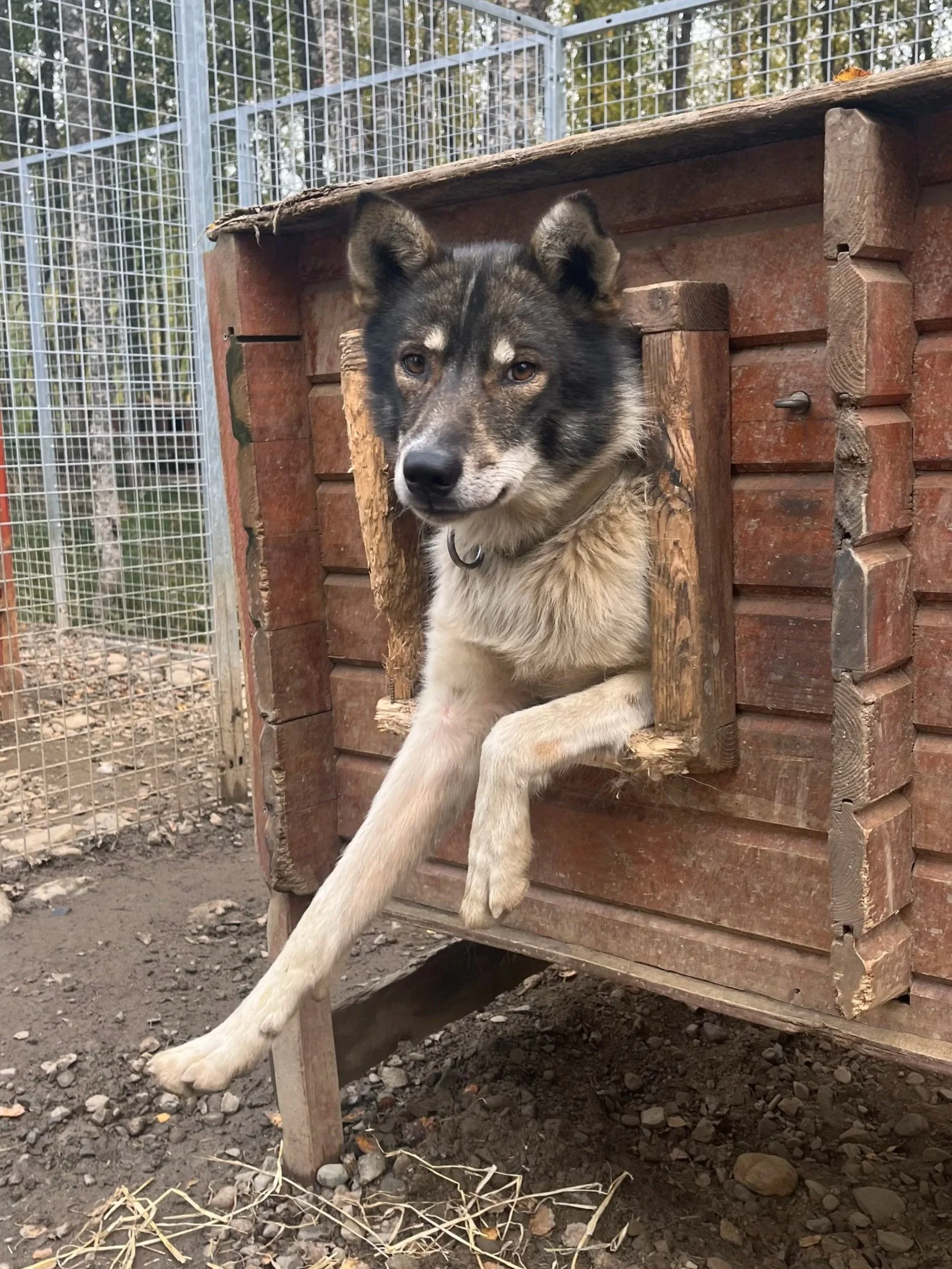
Humans in this system have at least some degree of choice. The dogs don’t.
Humans can, at least theoretically, speak up. A guide can resign. An employee can complain. An owner can change a business model. A traveller can choose another provider.
Dogs don’t have an HR department where they can file a complaint.
A dog communicates differently.
A dog refuses to leave its cage.
A dog doesn’t want to run.
A dog becomes stressed.
A dog fights.
A dog withdraws.
And humans decide what that means.
Dogs have to rely on their caretakers to be their guardians.
The more of a dog’s life we decide, the greater our responsibility for the life those decisions create.
These dogs don’t exist separately from the business. Without them, there is no dog-sledding experience. We breed them, train them, house them, decide when they run and who they run with. We decide whether they are bred, when they retire and, often, where they will spend the rest of their lives.
And we make money from the experiences they make possible.
That gives us a responsibility that goes beyond simply meeting welfare standards.
So, what allows people to make good choices?
And perhaps just as importantly: good choices for whom?
The business?
The employee?
The guest?
The dog?
Sometimes those interests align beautifully.
Sometimes they don’t.
And when they don’t, the dog has the least power in the negotiation.
I don’t have all the answers. If anything, the longer I work in this industry, the more questions I seem to have. But perhaps that isn’t a bad thing.
Maybe part of our responsibility is to keep asking the difficult questions. To question what has become normal. To look honestly at our own choices and the systems that shape them. And to remain willing to change when the answers make us uncomfortable.
Perhaps that is where moving forward begins.
There is a loud crackling sound coming from the bushes further down the yard.
Navara jumps up.
There she goes!
She sprints off into the bushes just as Karim steps onto the porch and sees her go.
‘She is so fast. She could have been such a great sled dog,’ he says with a smile.